How to Choose Orthopedic Drill Bits: Solid vs Cannulated, AO Quick Connect vs Round Shank
How to choose orthopedic drill bits with ZHONGJIAN TECH: solid vs cannulated, AO Quick Connect vs round shank, diameters 1.5-6.5 mm, lengths 80-350 mm.
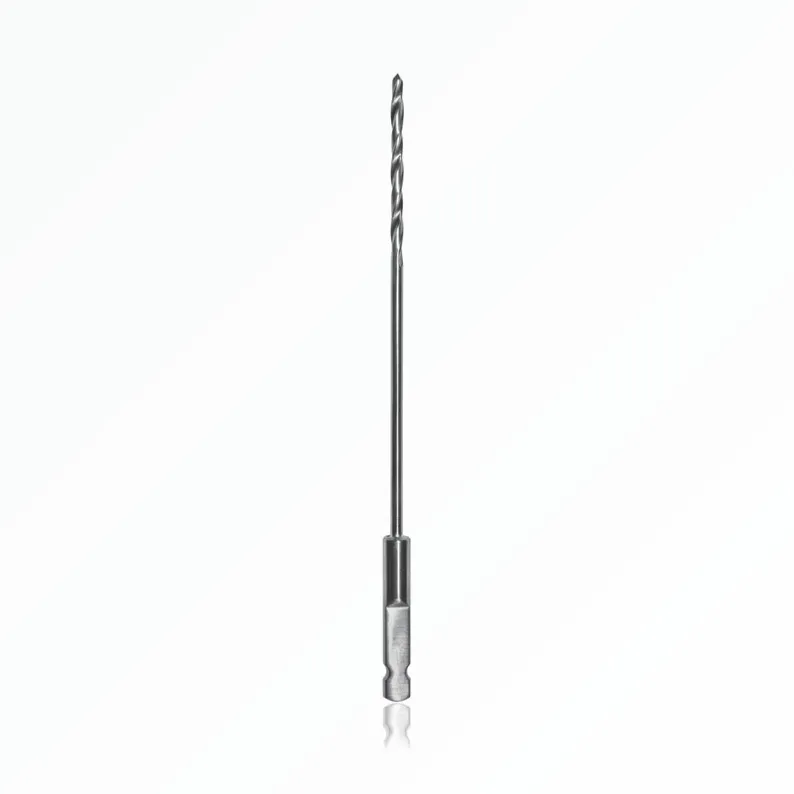
Choosing an orthopedic drill bit is a practical decision, not a guessing game. The right bit matches four things at once: the type of drilling you need to do, the coupling on the handpiece or power tool you already use, the diameter of the hole, and the length the anatomy and the approach require. Get one of those four wrong and the bit either does not fit the driver, does not reach the target, or leaves a hole of the wrong size. This guide explains how the ZHONGJIAN TECH drill range is organised, so a buyer can work through those four decisions in order and arrive at a part number that can be ordered with confidence.
ZHONGJIAN TECH supplies four drill families: Twist Drills with an AO Quick Connect coupling, Twist Drills with a Round Shank, Cannulated Drills with an AO Quick Connect coupling, and Cannulated Drills with a Round Shank. All four families share the same diameter range and the same overall length range, which makes comparison straightforward. The differences that matter are whether the drill is solid or cannulated, and which coupling it carries. Everything else — diameter, length and part number — follows from those two choices.
Solid Twist Drills vs Cannulated Drills
The first decision is between a solid twist drill and a cannulated drill. A solid twist drill is a single piece with a cutting point and a fluted body. It is the standard choice when the surgeon drills a hole directly, without first placing a guide wire. A cannulated drill has a hollow channel running through its length, so it can slide over a guide wire that has already been placed. The guide wire sets the path, and the cannulated drill follows it.
That difference is the whole point of the cannulated design. If the procedure uses a guide wire, a cannulated drill is the matching tool. If it does not, a solid twist drill is the matching tool. There is no advantage in using a cannulated drill without a guide wire, and no way to use a solid drill over a guide wire that is already in place. So the question to ask first is a simple one: does this procedure place a guide wire before drilling, or not? The answer settles the solid-versus-cannulated choice before any size is considered.
ZHONGJIAN TECH lists its cannulated drills in two families. Cannulated Drills - AO Quick Connect have a cannulation of 0.8 to 2.5 mm. Cannulated Drills - Round Shank have a wider cannulation of 0.8 to 5.5 mm. Cannulation is given as a range in the catalog, not as a value for each individual part number, so a buyer should confirm the guide-wire size they use before ordering. The wider range of the round-shank cannulated family accepts larger guide wires than the AO family, and that is a real difference between the two families that is worth checking when the guide-wire size is known.
AO Quick Connect vs Round Shank
The second decision is the coupling — the end of the drill that connects to the driver. ZHONGJIAN TECHoffers six coupling types across its drill range: AO Quick Connect, ST Round Shank, Jacob Quick, 1/4 SQ, Hudson and Mini AO. The four products on the site are built around the two most widely used couplings, AO Quick Connect and Round Shank, and the other four couplings are listed as available couplings on the drill pages rather than as separate products.
An AO Quick Connect coupling is a quick-connect fitting. It is designed to be fitted and removed quickly, without a chuck key, and it locks into a matching AO receiver. A round shank, by contrast, is a plain cylindrical shank that is gripped by a chuck. The choice between them is decided by the equipment already in use: if the handpiece or power tool has an AO receiver, order the AO Quick Connect family; if it has a chuck, order the Round Shank family. A drill with the wrong coupling will not fit, however well its diameter and length match.
That is why the coupling should be checked before the size. It is also why the part numbers make the coupling visible at a glance. Twist drills with the AO Quick Connect coupling carry part numbers beginning with AO, for example AO15080 and AO20100. Twist drills with a round shank carry part numbers beginning with ST, for example ST15080 and ST30200. Cannulated drills follow the same logic with CAO for the AO Quick Connect family and CST for the Round Shank family, for example CAO15080 and CST15080. Once the coupling is known, the prefix of the part number is already settled.
Sterile supply is handled the same way across all four families. Add S to the end of the part number for a sterile drill, for example AO-XXXXXS. This suffix rule applies to the whole drill range, so it is worth confirming at the ordering stage whether sterile or non-sterile supply is required.
Diameter Selection
All four ZHONGJIAN TECH drill families are offered in the same diameter set, with one exception noted below. The diameters are 1.5, 1.8, 2.0, 2.5, 2.7, 3.0, 3.2, 3.5, 3.8, 4.0, 4.2, 4.5, 4.8, 5.0, 5.5, 6.0 and 6.5 mm. That is seventeen diameters, stepping from the smallest at 1.5 mm to the largest at 6.5 mm. The diameter is the first number in the part number after the prefix: AO15080 is a 1.5 mm drill, AO20100 is a 2.0 mm drill, and AO65350 is a 6.5 mm drill.
Diameter selection is a clinical decision, made by the surgical team for the procedure and the bone concerned, and it is also the decision that fixes the part number. A buyer should therefore confirm the diameter with the surgical team before ordering, and should check it against the full list rather than assuming a diameter is available. Most diameters are available in all four families, but there is one exception in the round-shank cannulated family. Cannulated Drills - Round Shank are offered in 1.5, 1.8, 2.0, 2.4, 2.5, 2.7, 3.0, 3.2, 3.8, 4.0, 4.2, 4.5, 4.8, 5.0, 5.5, 6.0 and 6.5 mm. In that family a 2.4 mm diameter is available, and a 3.5 mm diameter is not. That detail is easy to miss, and it matters: a 3.5 mm cannulated round-shank drill cannot be ordered, while a 2.4 mm one can. The other three families include 3.5 mm and do not include 2.4 mm, so the diameter list should be checked family by family rather than assumed to be identical.
Length: Overall Length and Effective Length
Overall length for all four families runs from 80 to 350 mm. But the length a buyer can actually order depends on the diameter, and the effective length depends on the coupling family. Both points deserve care.
First, effective length. For the AO and CAO families — Twist Drills - AO Quick Connect and Cannulated Drills - AO Quick Connect — the catalog gives both an overall length and an effective length, where effective length equals overall length minus 25 mm. That gives an effective length range of 55 to 325 mm. For the Round Shank families — Twist Drills - Round Shank and Cannulated Drills - Round Shank — the catalog gives overall length only, with no effective length column. The 25 mm difference in the AO families is the part of the drill taken up by the shank and coupling end. A buyer who needs a particular working depth should therefore check whether the figure they are working from is overall length or effective length, and should use the effective length for the AO and CAO families.
Second, the diameter-dependent length limits. Not every diameter is available at every length. Drills of 1.5 to 2.0 mm go up to 200 mm in overall length. Drills of 2.5 and 2.7 mm go up to 350 mm. Drills of 3.5 mm and above start at 100 mm in overall length. These limits apply across the drill families, and they are the reason a part number should always be checked as a combination, not as a diameter and a length chosen separately. A 1.5 mm drill at 350 mm, for example, is not in the range, while a 2.7 mm drill at 350 mm is. The part-number examples in the catalog show how the combination works: AO15080 is a 1.5 mm drill at 80 mm overall length, AO20100 is a 2.0 mm drill at 100 mm, and AO65350 is a 6.5 mm drill at 350 mm. In the cannulated AO family, CAO27140 is a 2.7 mm drill at 140 mm, an extra 140 mm length offered at 2.7 mm and 3.2 mm, and CAO65350 is a 6.5 mm drill at 350 mm. In the cannulated round-shank family, CST24140 is a 2.4 mm drill at 140 mm, and CST65350 is a 6.5 mm drill at 350 mm.
Cannulation and Guide-Wire Sizing
For cannulated drills, the cannulation range is the third size to confirm, after diameter and length. As noted above, the AO Quick Connect cannulated family has a cannulation of 0.8 to 2.5 mm, and the Round Shank cannulated family has a cannulation of 0.8 to 5.5 mm. The catalog gives cannulation as a range, not as a value for each part number, so the buyer should confirm the guide-wire size they use and check it against the range before ordering. If the guide wire is larger than 2.5 mm, the round-shank cannulated family is the one whose range covers it. If the guide wire is within 0.8 to 2.5 mm, either cannulated family covers it, and the coupling decides between them.
This is also the point at which the rest of the set should be checked. A cannulated drill is used over a guide wire, and that guide wire is itself a product in the ZHONGJIAN TECH range. K-Wires (Kirschner Wires) are supplied in diameters from 0.7 to 1.6 mm and lengths from 102 to 229 mm, and they are used as guide wires and as temporary fixation pins. Checking the wire diameter against the cannulation range at the same time as ordering the drill avoids a mismatch between the two.
Reading a Drill Part Number
The part-number system is consistent enough that a buyer can read a part number and know what it describes. For twist drills with an AO Quick Connect coupling, the pattern is AO followed by the diameter multiplied by ten, followed by the overall length. AO15080 is therefore a 1.5 mm drill, 80 mm long. AO20100 is a 2.0 mm drill, 100 mm long. AO65350 is a 6.5 mm drill, 350 mm long. For twist drills with a round shank, the pattern is ST followed by the same diameter and length figures: ST15080, ST30200 and ST65350. For cannulated drills, the pattern adds a C before the coupling letters: CAO15080, CAO27140 and CAO65350 for the AO family, and CST15080, CST24140 and CST65350 for the round-shank family. Add S at the end for sterile supply.
That system also makes it easy to spot an error before ordering. If a part number does not follow the pattern, or if its diameter and length combination falls outside the limits given above, it should be queried rather than ordered. The product pages for Twist Drills - AO Quick Connect list the full diameter set, the length range and the length limits, and they are the place to check a part number before placing an order.
How to Order
Ordering a drill bit from ZHONGJIAN TECH comes down to four answers, in this order. First, solid or cannulated: does the procedure use a guide wire? Second, coupling: AO Quick Connect or Round Shank, to match the driver already in use? Third, diameter: which of the seventeen diameters, checked family by family, including the 2.4 mm and 3.5 mm exception in the round-shank cannulated family? Fourth, length: overall length within 80 to 350 mm, within the diameter-dependent limits, and effective length rather than overall length for the AO and CAO families where that distinction applies. Add the sterile suffix S if sterile supply is required, and confirm the guide-wire size against the cannulation range for cannulated drills.
Working through those four questions in order produces a part number that can be checked against the catalog and ordered without ambiguity. If any of the four answers is uncertain — the coupling on an unfamiliar driver, the guide-wire size, or a diameter and length combination at the edge of the range — it is better to confirm before ordering than to order a drill that does not fit. ZHONGJIAN TECH lists the full ranges on each drill product page, and the ordering team can confirm a part number against those ranges before supply.